
Overview
DEXSORB is a regenerable adsorbent media offering a cradle-to-grave solution in per- and polyfluoroalkyl substances (PFAS) treatment. Effective desorption of PFAS from spent media is not only a critical step for enabling sustainable media reuse, but also for concentrating PFAS waste for its safe and cost-effective destruction. DEXSORB regeneration is achieved in a simple and mild up-flow wash process for desorbing PFAS from spent media, followed by further concentration of PFAS waste via distillation. This process results in complete PFAS recovery and high overall concentration factors relative to treated water for media used in drinking water (500,000x) and non-drinking water (80,000x) treatment systems.
DEXSORB Regeneration
Performed under ambient conditions, the regeneration process involves multiple up-flow wash cycles using a regeneration solution of ethanol/water mixture amended with salt. The ethanol/water solution mixture triggers the reversal of hydrophobic interactions between PFAS and cyclodextrin cavities by creating a more hydrophobic environment outside the cavity with increased solubility. This provides for full PFAS desorption and recovery from spent media. This mild process does not alter the stability or integrity of adsorption sites (i.e., cyclodextrin cavities) which is a key factor in the yield and reusability of regenerated media.
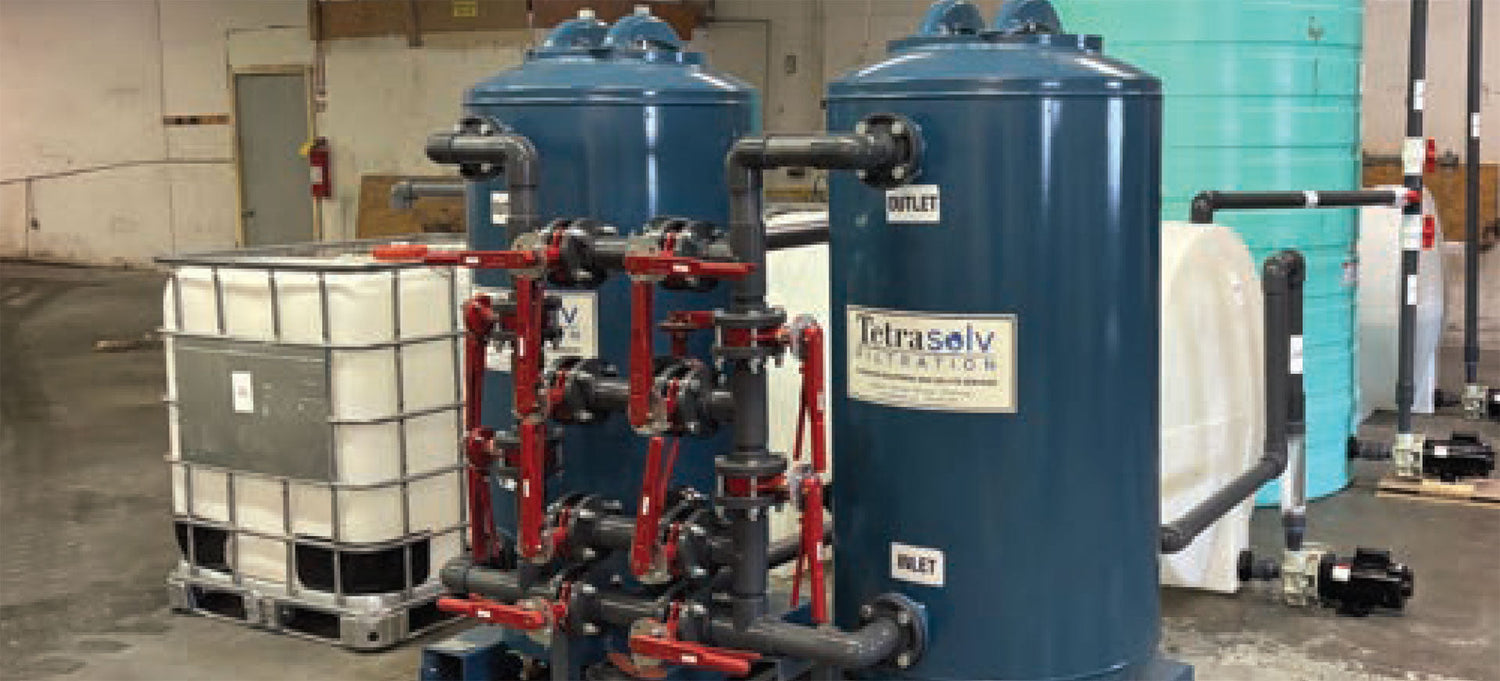
During each regeneration cycle, fresh regeneration solution is recirculated through DEXSORB-loaded vessels in up-flow mode for a short time period. This design ensures proper fluidization of granules for most efficient contact between solution and particles, promoting effective PFAS desorption. At the end of each cycle, spent regeneration solution (with desorbed PFAS) is collected for further concentration. A new up-flow wash cycle is then started with fresh regeneration solution to promote PFAS desorption. This process is repeated for multiple cycles until complete PFAS recovery is achieved, resulting in reusable regenerated DEXSORB media.
PFAS Waste Concentration
The spent regeneration solution collection is processed via distillation. The distillation step allows for efficient management of spent regeneration solution by (i) recycling over 90% of ethanol for reuse, and (ii) concentration of residual solution to a low-volume PFAS still bottom waste. Still bottom waste is transported to a PFAS destruction facility. The still bottom waste solution is compatible with multiple destruction technologies, including incineration, super critical water oxidation, UV reduction, and electron beam.
[/et_pb_text][et_pb_image src="https://cyclopure.com/wp-content/uploads/2026/04/dexsorb-regeneration-and-con-2.jpg" _builder_version="4.27.5" _module_preset="default" theme_builder_area="post_content" title_text="dexsorb-regeneration-and-con-2" hover_enabled="0" sticky_enabled="0"][/et_pb_image][et_pb_image src="https://cyclopure.com/wp-content/uploads/2026/04/graph-001.jpg" _builder_version="4.27.5" _module_preset="default" theme_builder_area="post_content" title_text="graph-001" hover_enabled="0" sticky_enabled="0"][/et_pb_image][et_pb_text _builder_version="4.27.5" _module_preset="default" theme_builder_area="post_content" header_3_text_color="#000000" hover_enabled="0" sticky_enabled="0"]
Features & Benefits
- Simple Operation: Performed in a series of up-flow washes under ambient
- Versatile: Equally effective process for spent media from drinking water and non-drinking water
- PFAS Recovery: Full desorption is achieved, affording clean regenerated
- Media Reuse: Regenerated media retains equal PFAS removal performance and physical properties as first-use
- Efficient Waste Handling: Concentrates PFAS into smaller volumes (80,000–500,000x factor) for cost-effective
Centralized Regeneration Operation
Successful regeneration of spent DEXSORB media with high PFAS recovery rates and concentration factors has been demonstrated in pilot-scale vessels (100 lbs) and small-scale vessels (500 lbs) at a centralized regeneration facility in Indiana. Cyclopure is currently building a large-scale regeneration facility in Michigan. This operation will provide a capability of
processing 4,000 lbs of spent DEXSORB per batch and concentrating PFAS waste by distillation for its efficient handling.
DEXSORB Regeneration Case Study
A complete demonstration of regeneration-concentration-destruction process was conducted using spent DEXSORB media from a drinking water pilot treatment in Massachusetts. The influent water source in this pilot treatment was groundwater and total PFAS concentration was 25 ppt. After loading spent media into regeneration vessel, a brief water backwash was performed for conditioning, prior to performing 10 cycles of regeneration. During each cycle, ~1.5 bed volumes of regeneration solution containing a mixture of ethanol, water and salt were recirculated through the vessel in up-flow mode for 1 hour. The particular regeneration solution composition was previously optimized to improve desorption efficiency as well as achieve faster distillation speeds and higher ethanol content in the still bottom waste. Spent regeneration solution with a total PFAS concentration of 150 ppb was processed by distillation, yielding (i) clean ethanol for reuse and (ii) concentrated PFAS still bottom waste that was sent to a certified PFAS incineration facility.
A PFAS recovery rate of 97% was achieved following the abovementioned 10-cycle regeneration process. Desorption of carboxylic PFAS proceeded rapidly and their near-quantitative recovery was accomplished in less than 5 cycles. Complete recovery of sulfonic PFAS required additional regeneration cycles, which is expected due to their stronger adsorption affinities compared to carboxylic PFAS. The residual PFAS level was only 0.0000164% of regenerated media by mass. Regenerated DEXSORB did not leach any PFAS when tested with the extraction buffer solution specified in the NSF 61 Standard, confirming suitability for reuse. The regenerated DEXSORB media demonstrated equal PFAS removal performance to first-use DEXSORB.
[/et_pb_text][et_pb_image src="https://cyclopure.com/wp-content/uploads/2026/04/dexsorb-regeneration-and-con-3.jpg" _builder_version="4.27.5" _module_preset="default" theme_builder_area="post_content" title_text="dexsorb-regeneration-and-con-3" hover_enabled="0" sticky_enabled="0"][/et_pb_image][/et_pb_column][/et_pb_row][/et_pb_section]