

PFAS do not change the color, taste, or smell of your water. Testing is the only way to know whether they are there. If you are wondering how to test for forever chemicals in water, the short answer is a laboratory analysis. The longer answer matters more. Accuracy depends on the analytical method, the way the sample is collected, and the reporting limit the lab can reach. It also depends on making sense of the numbers once they arrive. Here is what separates a reliable PFAS test from a comforting guess.
Why Standard Water Tests Miss PFAS
Most hardware store kits screen for hardness, chlorine, pH, iron, or lead. None of them detect PFAS. Forever chemicals are measured in parts per trillion. That scale sits far below what any color-change strip can read.
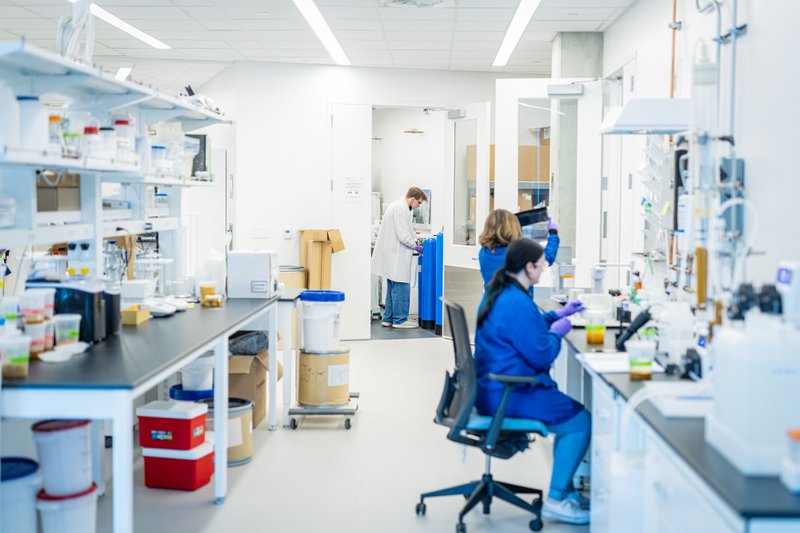
Real PFAS analysis happens on laboratory instruments. Labs use liquid chromatography paired with tandem mass spectrometry. They also use isotope dilution, which corrects for losses during sample handling.
Three EPA methods define this work. Method 537.1 targets longer-chain PFAS in drinking water, while method 533 adds shorter-chain compounds. Method 1633 covers 40 analytes across more complex water types. Each method carries a different compound list. Ask which method a test follows, and how many analytes it reports.
How to Test for Forever Chemicals in Water the Right Way
Instruments are only half the story. Collection is where many results quietly go wrong.
PFAS appear in tape, coatings, waterproof fabrics, and food packaging. Traces can transfer into a sample during handling or transport. Shipping bottles of water across the country adds handling steps, temperature swings, and holding-time limits.
Watch these variables closely:
- Analyte count. A six-compound panel tells you much less than a 40-compound panel.
- Reporting limit. A non-detect at 20 ppt is not the same as a non-detect at 1 ppt.
- Sample point. Kitchen tap results differ from results pulled after a treatment system, although water softeners alone will not affect results.
- Flushing. Follow the instructions on run time before you fill the container.
- Chain of handling. Fewer transfers between collection and analysis means fewer chances for contamination.
Various organizations, including community science initiatives, university research programs, and environmental organizations, take these details seriously. Volunteers monitoring and tracking PFAS in rivers and streams across the country follow strict handling steps on every single sample.
The Challenge of Interpreting Your Results
Knowing how to test for forever chemicals in water is only half the work. A number on a report helps only if you know the benchmark. That benchmark keeps moving.
EPA finalized the first federal drinking water limits for PFAS in April 2024. The maximum contaminant level (MCL) for PFOA and for PFOS is 4 parts per trillion. The agency also set non-enforceable, health-based maximum contaminant level goals (MCLGs), and it placed the MCLG for PFOA and PFOS at zero. An MCL is enforceable. An MCLG is a target with no enforcement behind it. That gap confuses a lot of households.
The picture shifted again this year. In May 2026, EPA proposed two rules. One upholds the PFOA and PFOS standards while letting systems request two extra years, moving compliance to 2031. The other would rescind the drinking water regulations for PFHxS, PFNA, HFPO-DA (GenX), and the hazard index mixture. Until those proposals are finalized, the 2024 limits stay on the books.
Two more points deserve attention. Federal MCLs apply to public water systems, and they do not cover private wells. Several states also enforce their own PFAS standards, and some are stricter than the federal ones. If a result leaves you unsure, our frequently asked questions walk through what the numbers mean.
How to Test for Forever Chemicals in Water Without Mailing a Sample
Cyclopure came at this problem from the materials side. Our materials scientists and environmental engineers developed DEXSORB®, a renewable adsorbent built from beta-cyclodextrins derived from plant starch. It is molecularly selective for PFAS. The same media used in treatment systems sits inside a small extraction disc in the Water Test Kit Pro.
Here is what changes: You fill the collection cup with water at your tap or well, or take it into the field at any river, stream, or lake. Water passes through the DEXSORB® disc, and the PFAS stay locked in the media. You simply drain the cup and mail back the entire unit, leaving the internal disc securely inside. By extracting contaminants at the point of collection, the sample is preserved in its on-site condition while eliminating the weight and hassle of shipping liquids, all without ever needing to remove the internal test disc.
The kit is accurate, affordable, and easy to use. Return shipping within the USA is pre-paid, and results arrive on a 10- to-14-business-day turnaround. The lab reports 55 PFAS analytes, including all 40 EPA Method 1633 compounds. Quantification runs to 1.0 ppt, and the analytical methods are validated to the requirements of EPA Methods 533, 537, and 1633.
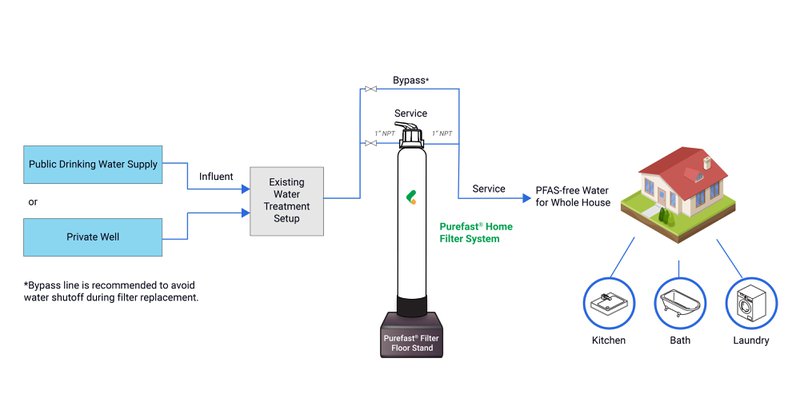
One honest note on certification. A certified method requires shipping water to the lab, so field extraction sits outside that path, even though the analysis follows the same isotope dilution procedures commercial labs use. Results also point toward next steps. If PFAS turn up, our home filtration options run on the same media, removing PFAS to non-detect levels for up to 80,000 gallons with Purefast® Home80 and up to 160,000 gallons with Purefast® HomeXtreme.
Start With a Number You Can Trust
You cannot filter what you have never measured. A test gives you a baseline and serves as an excellent screening method before you spend big on a commercial lab. While not accepted where litigation is pending, it tells you if treatment is worth the investment and gives you something concrete to bring to your utility, state agency, or neighbors.
If you draw from a private well, no federal rule requires anyone to test your water for you. That part is on you, and it does not have to be complicated or expensive. You can order a Water Test Kit Pro today and have the disc in the mail this week. If you would rather talk it through first, reach out to our team of scientists and engineers and we will help you find the right place to start.