

Most whole-home PFAS systems come in a range of sizes, from compact housings to tall vessels on your main water line. Size alone doesn’t tell you how well a system performs, though. The real difference is the media inside and how long it keeps capturing PFAS. That is why capacity is one of the most useful ways to compare a PFAS water filter whole house system.
Here's what that number really means and how to rank systems with confidence.
What Capacity Means for PFAS Water Filter Whole House Systems
Capacity is the volume of water, in gallons, that a system can treat before its media needs replacing. For PFAS water filter whole house systems, it tells you how long treatment lasts between replacements.
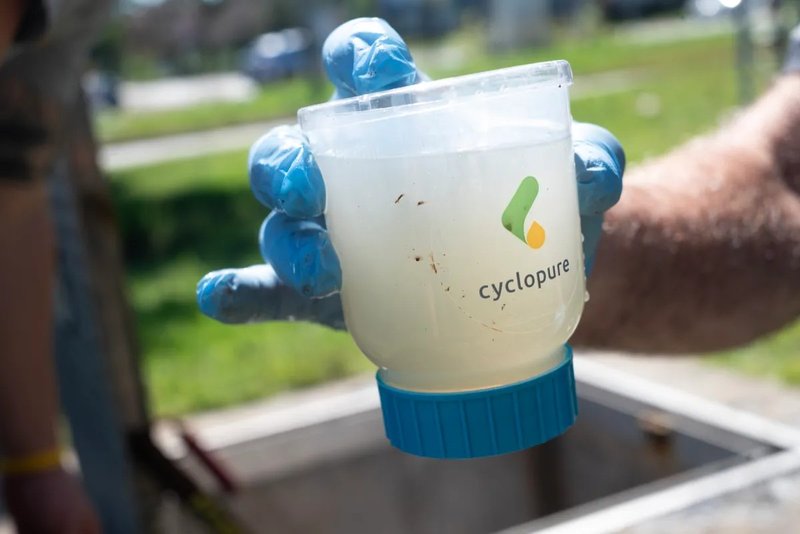
Most PFAS media work through adsorption. PFAS molecules attach to the media and stay there. Each adsorbent has a limited number of places to hold them. Once those places fill, PFAS can start passing through. Water professionals call this point breakthrough.
A capacity rating estimates when breakthrough will happen. That timing varies from home to home, based on several factors:
- Which PFAS are present. Compounds adsorb differently. On some media, short-chain PFAS reach breakthrough sooner than long-chain PFAS.
- PFAS concentration. Higher levels can fill the media faster.
- Water chemistry. Natural organic matter and other dissolved substances can compete with PFAS on some media.
- Flow rate and contact time. Water needs enough time in contact with the media to be treated.
- Household water use. More gallons per day means the media reaches its limit sooner.
A whole-home system treats every gallon entering the house, from showers to laundry. So its capacity must cover far more water than a single-tap device. Many well owners weigh whole-home treatment, since private wells fall outside federal drinking water rules.
How the Media Inside the Vessel Shapes Capacity
The media is the part that actually captures PFAS. Two systems can share the same tank size and still perform very differently. Common whole-home options include granular activated carbon (GAC), anion exchange resin, and newer specialty adsorbents.
Activated carbon has been the standard adsorbent for decades. The EPA calls it the most studied PFAS treatment. It works well on longer-chain compounds such as PFOA and PFOS. Shorter-chain compounds, such as PFBS and PFBA, do not adsorb as well. EPA researchers note that carbon works for a limited period. That period depends on the carbon type, bed depth, flow rate, and the specific PFAS present. Organic matter and other substances in the water play a role too.
This is where a familiar sales line falls short. Carbon-based systems are often sold with the promise to "set it and forget it." With PFAS, that promise no longer applies. Once carbon uses up its capacity, PFAS can begin passing through. Fresh carbon is then needed to keep adsorbing PFAS. A sound replacement schedule should track PFAS performance, not habit.
Anion exchange resin is another option. The EPA notes it has a high capacity for many PFAS, though it typically costs more than GAC. Like carbon, resin also works for a limited time. Emerging technologies called specialty adsorbents are designed to target PFAS more selectively. That selectivity can help limit competition from other substances in the water.
All adsorbent media eventually fill. Spent media still holds the PFAS it captured, so it’s best to research what happens to it after replacement. Some media can be regenerated, with captured PFAS concentrated for destruction.
Why Your Test Results Shape the Capacity You Need
Before you rank any PFAS water filter whole house option, start with what is in your water. A test shows which PFAS are present and at what levels. Those details affect how quickly media fills. They also show whether short-chain compounds need attention. Here's how to know if you have PFAS in your water.
Reading the results can be a real challenge, because EPA rules on MCLs and MCLGs keep changing. A Maximum Contaminant Level (MCL) is an enforceable limit for public water systems. A Maximum Contaminant Level Goal (MCLG) is a non-enforceable, health-based goal. In 2024, the EPA set MCLs for six PFAS, including 4.0 parts per trillion (ppt) each for PFOA and PFOS.
In May 2026, the EPA proposed two changes. One would rescind the MCLs and MCLGs for PFHxS, PFNA, HFPO-DA (GenX), and the Hazard Index mixture. The other would extend the PFOA and PFOS compliance deadline from 2029 to 2031. As of early October 2026, an industry update listed the rescission as still pending.
So one result can read differently depending on the benchmark. Compare each compound to the current federal level, and note whether that level is under review. Your state's own standards add useful context, too.
Ranking Purefast® PFAS Water Filter Whole House Systems by Capacity
Cyclopure's materials scientists and environmental engineers developed DEXSORB® with one goal in mind: capturing PFAS. Many of them are homeowners and gardeners too, so the work feels personal. DEXSORB® is a renewable adsorbent made from a derivative of corn and potato starch. Like carbon, it is an adsorbent. Unlike carbon, its cup-shaped molecules are designed to target PFAS. That molecular selectivity is designed to limit competition from other substances in the water.
That design matters for capacity. In rapid small-scale column tests with consultant EKI, using groundwater from a Northern California utility, a DEXSORB® formulation showed greater treatment capacity than GAC for both short- and long-chain PFAS. In those tests, that meant the media kept adsorbing PFAS longer before breakthrough.
Two Purefast® point-of-entry (POE) systems put DEXSORB® to work. Here's how they rank by tested capacity:
- Purefast® HomeXtreme: 160,000 gallons, or about 24 months of typical use. Rated at 8 gpm (12 gpm peak), with under 5 psi of pressure drop at 8 gpm.
- Purefast® Home80: 80,000 gallons, or about 12 months of typical use. Rated at 5 gpm (10 gpm peak), with under 5 psi of pressure drop at 5 gpm.
Cyclopure's product data shows both systems reducing eight PFAS to non-detect levels throughout filter service life, under tested conditions. These are PFOA, PFOS, PFHxS, PFBS, PFNA, PFDA, PFHpA, and GenX. Neither system is "set it and forget it." Each has a defined replacement point tied to its tested capacity. Used vessels return through a filter exchange program, where captured PFAS is concentrated for destruction. For a single tap, Purefast® Countertop offers point-of-use (POU) treatment with no plumbing required.
Let's Match the Right Capacity to Your Home
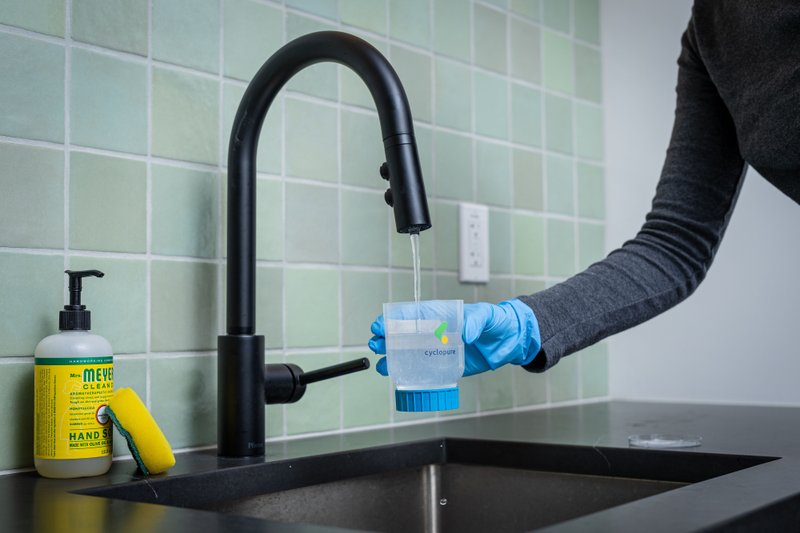
Choosing capacity is easier when you know your starting point. Our PFAS Water Test Kit Pro takes a different approach to testing. You never ship a water sample. Instead, you run your water through a cup holding a DEXSORB® extraction disc, then return only the cup. Analysis uses methods validated to EPA Method 533, 537 and 1633 criteria, per our published lab methodology. We designed the kit to be accurate, affordable, and easy to use. Return shipping within the USA is prepaid, and results typically arrive within 10 to 14 business days.
We're glad to help you read your report and choose a system sized for your household. You can compare whole-home systems and test kits in our shop. When you're ready, reach out to our team to find the PFAS water filter whole house system for your home.