

Water can look perfectly clear and still contain per- and polyfluoroalkyl substances. At drinking water concentrations, PFAS carry no taste, no odor, and no color. So the honest answer to how do I know if I have PFAS in my water is short. You cannot know without a laboratory test. Local history and public records can tell you whether your risk is elevated. Only an analysis of water from your own tap can confirm what is actually present.
Why PFAS Stay Hidden in Everyday Water
PFAS are a large family of synthetic chemicals used since the 1940s. They appear in nonstick coatings, firefighting foams, stain-resistant textiles, and grease-resistant food packaging. They resist breakdown in the environment, which is why many people call them forever chemicals.
The measurement scale explains the invisibility. PFAS in drinking water are reported in parts per trillion. One part per trillion is roughly one drop in 20 Olympic-sized swimming pools. Your senses cannot register concentrations that small.
Common water complaints are also unrelated. A chlorine smell points to disinfection. Cloudy water usually means air or sediment. Scale on a kettle indicates hardness. None of those signals say anything about PFAS. Hardware store test strips will not help either. They screen for chlorine, hardness, lead, and pH, not fluorinated compounds.
How Do I Know If I Have PFAS in My Water Based on Where I Live?
Location will not give you a result, but it does give you context. Several public sources hint at whether your area has a documented PFAS issue:
- Your utility's annual Consumer Confidence Report, which many systems now publish with PFAS results
- State environmental agency dashboards and PFAS sampling maps
- EPA monitoring data collected from public water systems under UCMR 5
- Proximity to airports, military installations, landfills, or industrial plating and textile operations
- Land near wastewater treatment facilities or fields where biosolids were applied
Well owners face a different situation. Private wells sit outside the Safe Drinking Water Act, so nobody tests them for you. Several states have responded with free testing in targeted counties, and state well testing programs have expanded quickly in recent years.
None of these clues actually measure your water. Two wells on the same road can return very different results. Groundwater plumes move unevenly, and treatment varies between systems.
How Do I Know If I Have PFAS in My Water Without a Laboratory Test?
You do not. Detection requires liquid chromatography with tandem mass spectrometry, run under EPA Methods 533, 537, and 1633. Before analysis, PFAS must be pulled out of the water through solid-phase extraction.
That extraction step is where testing methods diverge. The conventional route asks you to fill bottles and ship water to a laboratory. The lab performs the extraction days later. Shipping water is heavy, expensive, and adds handling steps along the way.

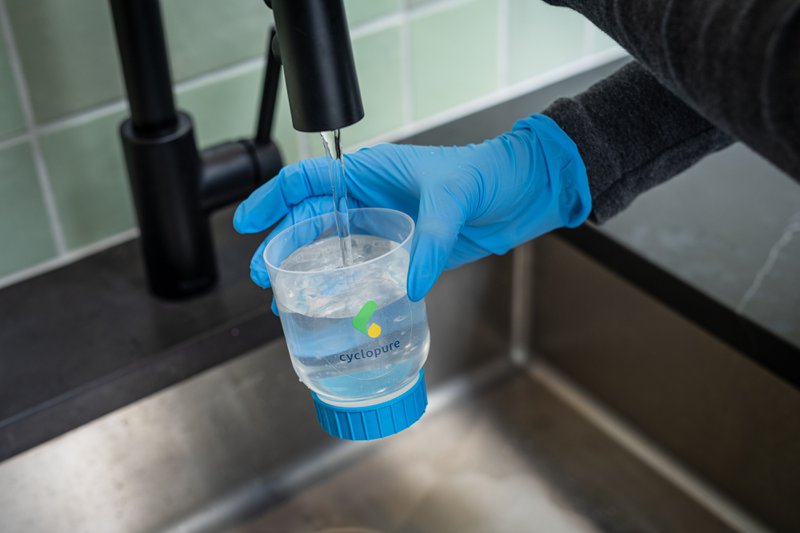
A newer approach moves extraction to the moment of collection. You pour a measured volume of water through a collection cup fitted with a sorbent-loaded disc. PFAS bind to the disc immediately, and only the disc travels to the lab. This point-of-collection method captures conditions at your tap in real time. It also removes water shipping from the process entirely.
Making Sense of Results When Regulations Keep Changing
Getting a number is only part of answering how do I know if I have PFAS in my water. Two terms drive most of the confusion. A Maximum Contaminant Level, or MCL, is a legally enforceable limit for public water systems. A Maximum Contaminant Level Goal, or MCLG, is a non-enforceable, health-based target.
The federal picture has shifted more than once. In April 2024, the EPA finalized enforceable limits touching six PFAS: individual limits of 4 parts per trillion for PFOA and PFOS, and 10 parts per trillion each for PFHxS, PFNA, and HFPO-DA (commonly known as GenX), plus a Hazard Index limit of 1 for any mixture containing two or more of PFHxS, PFNA, HFPO-DA, and PFBS. MCLGs for PFOA and PFOS were set at zero. In May 2025, the EPA announced plans to retain the PFOA and PFOS limits while rescinding and reconsidering the standards for the other four. Proposed changes went out for public comment in May 2026. Several states also set their own limits, and some are stricter than the federal numbers.
When you review a report, focus on a few practical points:
- Which compounds the lab tested, since panels vary widely
- The limit of quantitation, because "non-detect" only means below that threshold
- Whether short-chain compounds were included, as they behave differently from long-chain PFAS
- How your numbers compare to both current federal limits and your state's rules
Cyclopure built its PFAS Water Test Kit Pro to be accurate, affordable, and easy to use. The kit tests 55 PFAS analytes, including all 40 compounds covered under EPA Method 1633, quantified down to 1.0 part per trillion. Collection happens with a DEXSORB® loaded extraction disc, so you never ship water. Return shipping is prepaid within the United States, and results arrive within a 10 to 14 business day turnaround. If your numbers warrant treatment, Purefast® home filtration ranges from countertop to whole home.
Get a Clear Answer About Your Own Tap
You deserve better than guesswork about the water you drink every day. A test gives you a baseline, and that baseline tells you whether treatment makes sense for your household. Our team of materials scientists and environmental engineers reads these reports daily, and we are glad to help you understand yours. Order your test kit from our shop, or contact us to talk through results you already have.