

You drink from your tap every day, so news about forever chemicals in your water deserves a clear answer. Per- and polyfluoroalkyl substances (PFAS) now show up in many water sources, including private wells across the country. The EPA's own health goal for the Maximum Contaminant Level Goal (MCLG) of PFOA and PFOS is zero. But because there's no exposure level considered fully risk-free, the enforceable limit is set at 4 parts per trillion for practical detection and treatment reasons. Whether your well water needs immediate attention depends on which PFAS compounds you have and at what levels. The goal isn’t just to get under a legal number, it’s to remove to non-detect.
As materials chemists and environmental engineers, we believe good decisions start with accurate information, not alarm. Our team studies how PFAS behave in water, and we also drink from the same kinds of taps you do. Here you will find what the science says, how to read your results, and what to do next.
What PFAS in Well Water Mean for Drinking Safety
No single answer fits every home, because safety depends on which PFAS your water contains and their concentrations. The EPA's 2024 drinking water rule (EPA6) set enforceable limits on six PFAS, including a 4 parts per trillion (ppt) limit each for PFOA and PFOS. Our DEXSORB® filtration media is tested to completely remove the specific PFAS compounds down to non-detect levels and certified against NSF/ANSI/CAN Standard 61. Testing your tap shows where you stand, and our filter delivers complete removal of those named compounds at home.
What the Research Says About PFAS and Health
Scientists have studied PFAS for decades, and the evidence on health effects keeps growing more detailed. ATSDR's 2025 PFAS health effects overview (part of the CDC) and the EPA's own 2026 updated article of PFAS health risks both point to the same patterns: decreased antibody response to vaccines, increased cholesterol, decreased birth weight, and increased risk of certain cancers, including kidney cancer.
The report also found limited evidence for other outcomes, including thyroid disease, testicular cancer, and ulcerative colitis. Meanwhile, the EPA set a health-based goal of zero for perfluorooctanoic acid (PFOA) and perfluorooctane sulfonic acid (PFOS). Because the goal is non-enforceable, the agency paired it with the 4 ppt limit that public systems must meet.
The graphic below summarizes health effects researchers have linked to PFAS, though evidence strength varies by outcome. In other words, a link means scientists see an association, not proof that PFAS caused a specific illness.

Your personal risk depends on how much PFAS you take in, for how long, and from which sources. For many households, PFAS in well water are the exposure source you can measure and control most directly. Knowing your test numbers turns a vague worry into a clear decision you can act on today.
How to Read Test Results for PFAS in Well Water
A PFAS lab report can look overwhelming at first, with dozens of compound names and unfamiliar units. Most results appear in ppt, which equals nanograms per liter (ng/L) on many reports. When you review your report for PFAS in well water, focus on these key details first.
- Individual PFOA and PFOS results, which you can compare against the EPA's 4 ppt public water limits.
- Total PFAS detected, since short-chain and less common compounds can add up across a full panel.
- Non-detect results, which mean a compound fell below the lab's reporting limit on that sample.
- Reported ranges, which can appear when a smaller sample volume raises the lab's quantification limit.
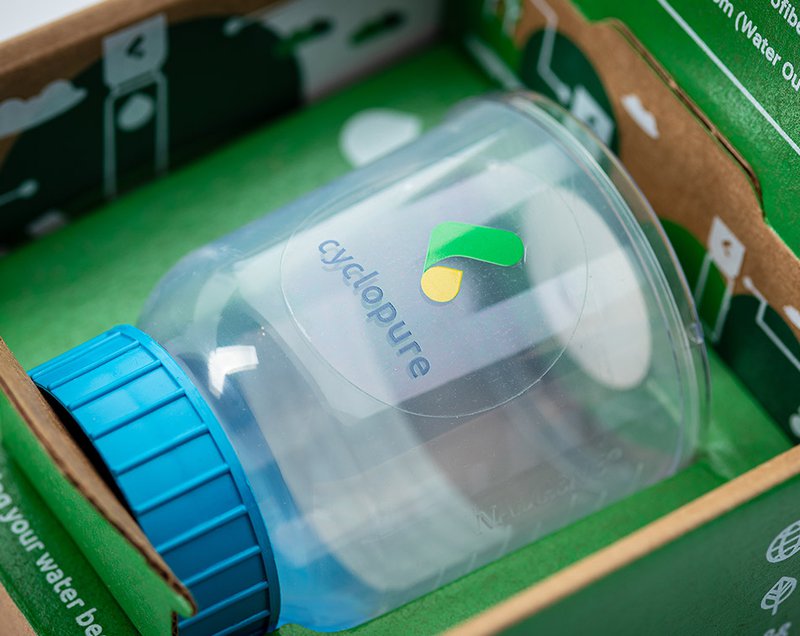
Your state health department may also publish PFAS guidance values to help private well owners interpret results. The Cyclopure Water Test Kit Pro reports 55 PFAS analytes down to 1.0 ppt for household screening. Your report arrives by email 10 to 14 business days after the lab receives your kit.
If any value surprises you, retest before making major decisions, since single samples can vary. Our team can also help you understand what each number means for your household.
Practical Steps When Your Test Finds PFAS in Well Water
Finding PFAS in your results gives you a clear starting point, and you have practical options. In the short term, bottled water or a point-of-use filter can cover drinking and cooking needs. The Purefast® Countertop fits pitchers that use standard-size Brita® filters, needs no installation, and is certified under NSF/ANSI Standard 53 for PFOA/PFOS reduction and Standard 42 for chlorine taste and color reduction.
Each Countertop filter treats 65 gallons, which lasts up to three months for a two-person household. However, showers, laundry, and appliances still draw untreated water throughout the rest of your home.
For long-term protection, a whole-home Purefast® system removes PFAS in well water at the point of entry. Every Purefast® Home vessel holds DEXSORB®, the same industrial-grade adsorbent used in large-scale PFAS treatment. In testing, our Home filters reduced eight PFAS, including PFOA, PFOS, and GenX, to non-detect levels.
Next, match the vessel to your household, choosing Home80 for 80,000 gallons or HomeXtreme for 160,000 gallons. After installation, a follow-up test confirms the system performs as expected with your water chemistry.
Finally, think about what happens to the PFAS your filter captures once the vessel reaches capacity. Our Used Filter Return Program collects spent vessels so captured PFAS can go through separation and destruction. As a result, the PFAS you remove from your water move toward destruction instead of simple disposal.
Get Clear Answers About Your Water From Cyclopure
PFAS in your water call for facts, and you now know what the research and regulations say. A reliable test shows your starting point, while a DEXSORB® filter gives you a way to act on it. Follow-up testing then keeps your picture current, so you always know where your water stands.
Our materials chemists and environmental engineers built every Cyclopure product around evidence, not guesswork. Whether you have a new test result or questions about filtration, we can help you sort through your options. Contact our team today to get answers about your water and find the right Purefast® solution.