
TFA in Drinking Water and How to Test for It
Trifluoroacetic acid (TFA) is the most common PFAS in tap water, and most filters miss it. Cyclopure now tests for TFA and is actively advancing technology to capture it.
What is TFA?
TFA is an ultrashort-chain PFAS that forms when larger PFAS break down. It is more abundant, water-soluble and mobile than the chemicals it comes from, which makes it harder to capture, and the carbon filters and treatment commonly used for PFOA and PFOS remove little of it. Europe recognizes TFA as a PFAS, but the U.S. EPA, which uses a narrower definition, does not.
The most common PFAS in tap water
TFA is now considered the most common PFAS, or "forever chemical," in the environment. It has been found in rain, soil, plants, food, oceans, ice, tap and bottled water, and human blood, and levels keep rising. In Indiana homes, it showed up in 95% of drinking water samples, making up 84% of all PFAS detected. In New Jersey, researchers found it in 64 of 70 tap water samples.
How TFA ends up in your water
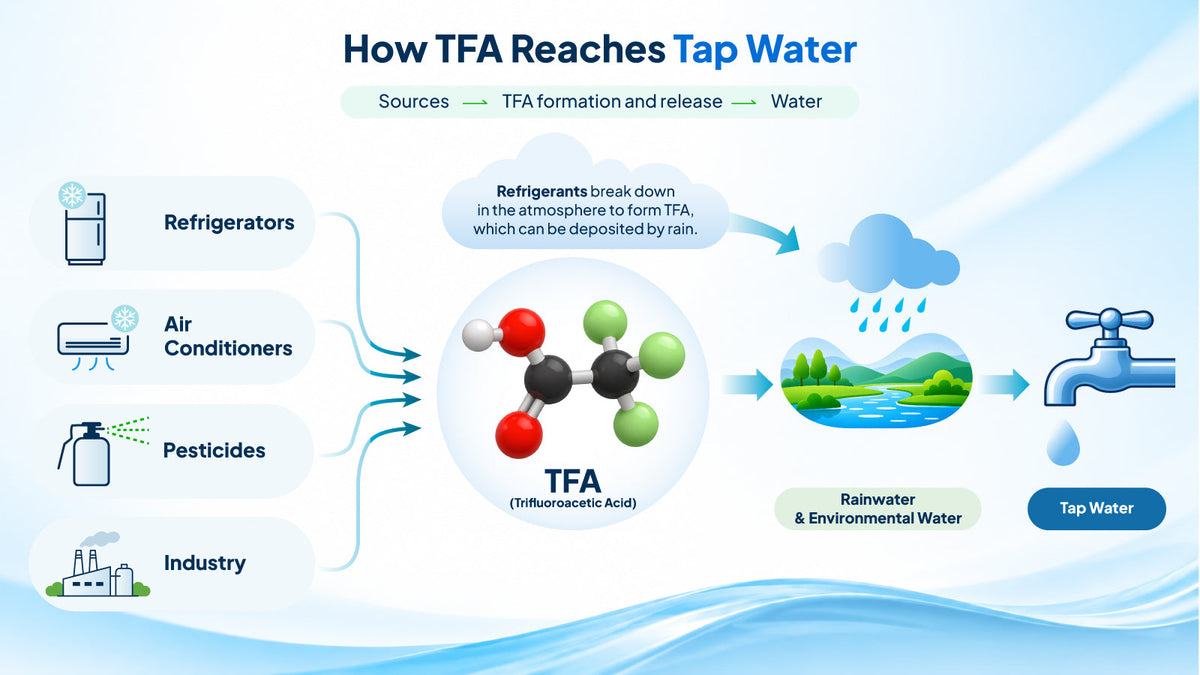
A major source of TFA is the cooling gases in refrigerators and air conditioners, which turn into TFA in the air before rain washes it back down. PFAS-based pesticides sprayed on crops are another, and a main cause of TFA in water. Some medicines also break down into TFA, and it can form when PFAS waste is burned, processed at sewage plants, or disinfected. Factories also make some TFA directly and release it during production.
Is TFA harmful to your health?
Far less is known about the health effects of TFA than those of other PFAS. Early research found that TFA was not immediately dangerous, and smaller PFAS were long assumed to pose lower risks. That view has shifted as TFA levels have risen.
Animal studies have linked TFA to liver enlargement at high doses, lower thyroid hormone levels, and eye and skeletal defects in developing fetuses. In 2026, a lab study using human cells found that even low doses of TFA can disrupt blood vessel cells, and European Union scientists recommended classifying TFA as toxic to reproduction. There are no studies of health effects in people, and the long-term effects of everyday exposure remain unknown.
TFA regulation today
There is no limit for TFA in U.S. drinking water, at either the federal or state level. The EPA has proposed testing public water systems nationwide for TFA under the Sixth Unregulated Contaminant Monitoring Rule (UCMR 6) starting in 2028, with the results made public. In Europe, TFA counts toward the EU limit of 0.5 parts per billion for all PFAS combined in drinking water, and several countries have set their own guidance values for it.
How to test your water for TFA
Testing is the only way to know whether TFA is in your water, and most standard PFAS tests do not include it. Cyclopure’s Water Test Kit Pro for PFAS now offers testing for TFA using EPA Method 563, the same method the EPA plans to use for national monitoring. It works for both drinking and non-drinking water and can detect TFA at levels below 20 parts per trillion (ppt).
Removing TFA from water
Cyclopure is actively developing DEXSORB® for TFA removal. Our initial tests show promising results for removing TFA, a strong signal for full-scale treatment.
FAQ
Is TFA a PFAS? Yes, by most scientific definitions. Europe classifies it as one, but the EPA’s narrower definition leaves it out.
Do water filters remove TFA? Most don’t. The carbon filters used for other PFAS capture little TFA. Cyclopure is developing DEXSORB® to remove it.
Is TFA in bottled water? Yes. Switching to bottled water does not necessarily avoid it.
How do I test my water for TFA? Use a test that runs EPA Method 563, such as Cyclopure’s Water Test Kit Pro for PFAS. Most standard PFAS tests don’t include TFA.